“For decades, access to venture capital was reserved for insiders.” Akka is changing that.
Companies We Backed Before The Public
Most of the money is made before you’re even allowed in.
Founding
Just an idea and a dream
Akka gives you access here
Seed
Early believers step in
Series A
The business model gets validated
Growth rounds
Professional investors step in
Pre-IPO
Before public investors can buy
Most people are stuck here
Public markets
Much of the growth already happened
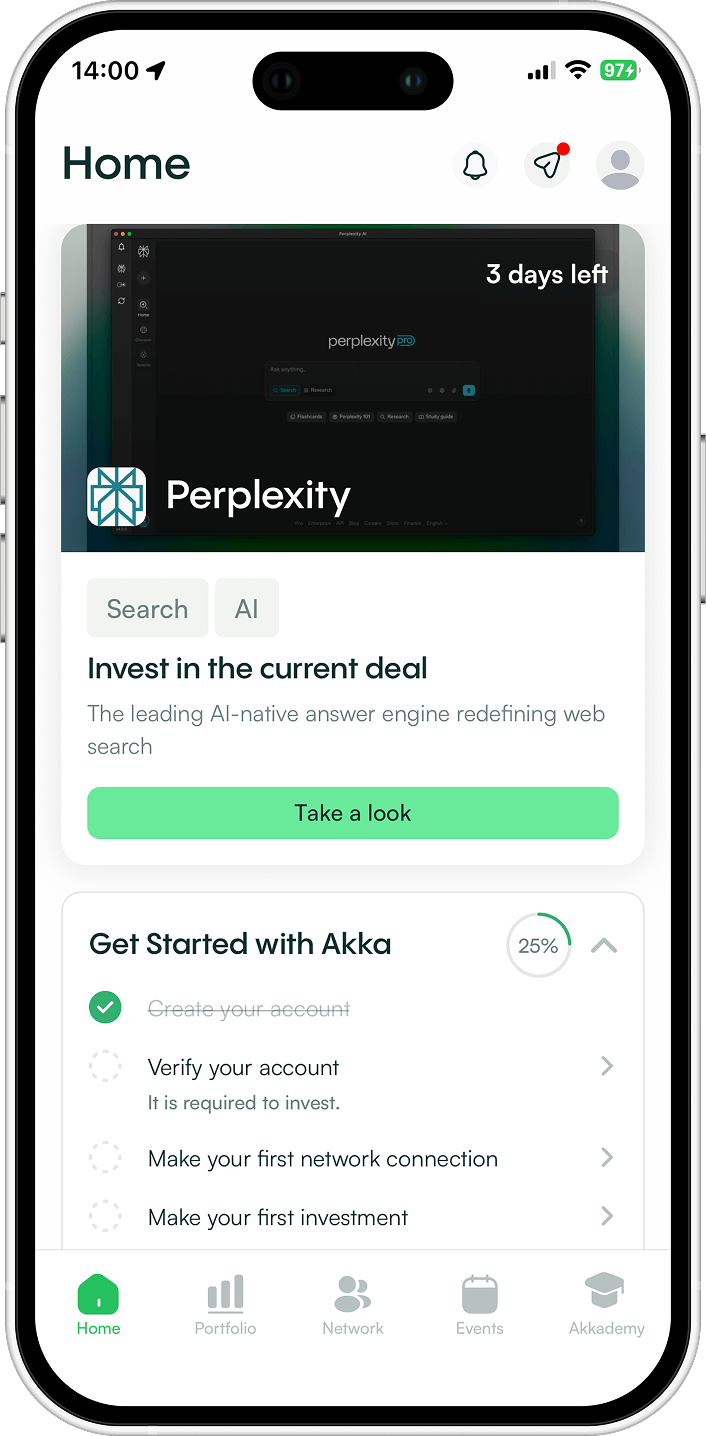
The first app in Europe that sends you deals once reserved for ultra-wealthy insiders.
Receive each month up to two exclusive opportunities to invest with us, ranging from early-stage disruptors to pre-IPO unicorns like Anthropic, Revolut, and Epic Games.
We reject 99,97% of startups
Every deal comes with full analysis and breakdowns
Get the same legal terms as professional investors
How is Akka different from investing in a traditional VC fund?
A traditional VC fund pools your capital into a blind structure. You commit money, the fund deploys it, and you receive periodic updates. You typically don’t choose individual companies and you don’t interact with founders directly. Akka works differently. We review private opportunities and invest through structured vehicles, and members can access the same deals on a deal-by-deal basis. You decide whether to participate in each opportunity and how to build your own portfolio. It’s not a blind fund commitment. It’s structured access to private deals with individual choice.
Why is there a membership fee?
The membership gives you access to the platform, the deal flow, the investment materials, founder sessions, and the investor network. Maintaining this infrastructure requires ongoing operational work, legal structuring, due diligence, and investor support. The membership fee funds that access layer. It does not obligate you to invest in any deal. You join for access, and you decide independently whether to deploy capital.
What fees apply when I invest in a deal?
When you invest in a deal, there are transparent deal-level costs. These can include structuring fees, SPV-related management costs, and in certain cases a performance fee on profits. Structuring fees vary depending on membership level, and SPV management fees may apply annually for a defined period. A performance fee is only charged if there is a realized gain. All applicable fees are disclosed before you invest in a specific opportunity so you can make an informed decision.
Do you take a percentage of my investment?
Certain deal-related costs are calculated as a percentage of the invested amount, such as structuring or SPV management costs, and these are clearly disclosed before you commit capital. In some cases, a portion of the investment may be retained within the vehicle to cover operational or administrative costs. Additionally, a performance fee may apply on profits if a successful exit occurs. There are no hidden charges, and you are not required to invest in any opportunity.
How do you select the companies that appear on the platform?
We review a large number of private opportunities and invest in a small fraction. The selection process includes evaluation of the company, its market, traction, leadership, and deal structure. Members receive documentation and investment materials outlining the opportunity, the thesis, and the key risks. Access does not mean endorsement for every investor profile. Each member remains responsible for assessing whether a specific deal fits their own strategy and risk tolerance.
What are the risks of investing through Akka?
Private investing carries significant risk. Startups can fail. Capital can be lost. Liquidity is limited and holding periods may extend for years. Valuations are not guaranteed and exits are uncertain. This model is designed for long-term investors who understand volatility and the possibility of loss. It should not be considered a substitute for cash reserves or short-term financial planning.
Is my capital locked in? What about liquidity?
Private market investments are inherently less liquid than publicly traded securities. There is no guaranteed secondary market and exits depend on company outcomes such as acquisitions, IPOs, or other liquidity events. Some opportunities may include mechanisms that improve transferability, but liquidity should not be assumed. You should only invest capital you are comfortable committing for the long term.
How many deals will I see per year?
Members typically see a limited number of curated opportunities per year rather than a high volume of listings. The focus is on selectivity rather than quantity. There is no obligation to invest in any specific number of deals. Portfolio construction remains your decision.
Can I speak directly with founders?
In many cases, members have access to founder sessions or live discussions where leadership presents the company and answers questions. Access formats vary by opportunity, but interaction and transparency are core parts of the model. This differs from traditional fund structures where investors rarely engage directly with portfolio company founders.
Who is Akka designed for?
Akka is designed for investors who already understand public markets and want structured exposure to private companies before IPO. It is suitable for individuals comfortable with long time horizons, startup risk, and portfolio diversification. It is not designed for those seeking guaranteed returns, short-term speculation, or full liquidity.
What happens if a company fails?
If a company fails, invested capital in that opportunity may be partially or entirely lost. That is part of private market risk. The model relies on portfolio diversification across multiple companies rather than concentration in a single deal. Losses in individual companies are a known characteristic of venture-style investing.
What happens after I apply to become an investor?
After you apply, your profile is reviewed to determine eligibility and suitability. If approved, you receive access to the platform, membership terms, and current or upcoming opportunities. From there, you decide independently whether and when to participate in specific deals. There is no obligation to invest after joining.










.svg)
.svg)









_logo%201.svg)
